


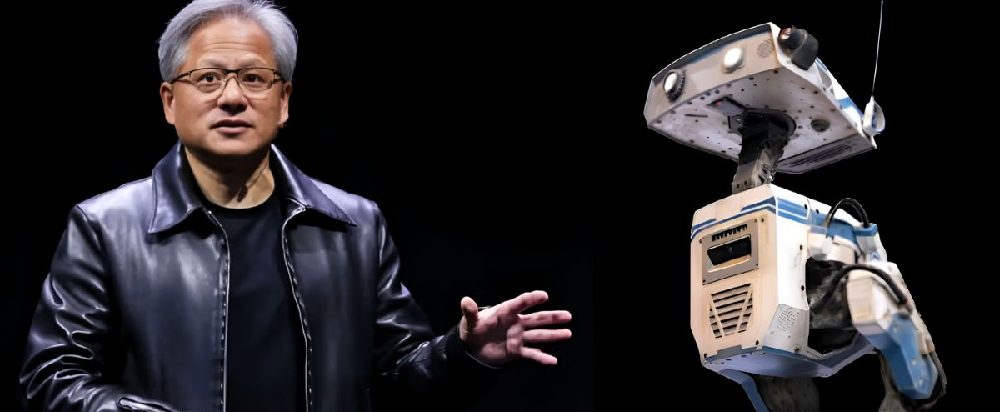
Nvidia has unveiled Isaac GR00T N1, a groundbreaking open foundation model designed to advance the deployment of humanoid robots globally. Announced at Nvidia’s GTC 2025, this AI-powered system equips robots with general reasoning abilities and adaptable motor skills, positioning them for faster integration into sectors facing labor shortages.
Humanoid robots, defined by their human-like design—torso, head, arms, and legs—are moving from sci-fi to reality. Industries like manufacturing, healthcare, retail, and hospitality are adopting them for tasks ranging from factory work to customer engagement.
Speaking at the event, Jensen Huang, Nvidia’s CEO, highlighted manufacturing as the likely first major adopter. “Humanoid robots operating in factories are no longer a five-year vision; it’s a near-term reality,” Huang said. He estimated that renting a humanoid robot could cost businesses around $100,000, delivering immediate value in structured environments like warehouses.
At the core of GR00T N1 is its dual-system architecture, modeled after human cognition. System 1 handles fast, reflexive decisions, while System 2 focuses on deliberate, contextual reasoning. Its vision-language model helps robots interpret their surroundings and execute multi-step tasks autonomously.
1X Technologies, a robotics firm based in Norway, showcased GR00T N1 in action during GTC 2025. A robot from their NEO Gamma series autonomously organized a room, demonstrating the model’s ability to generalize across domestic and industrial tasks. Bernt Børnich, CEO of 1X Technologies, emphasized that Nvidia’s technology has accelerated their progress toward building robots that can meaningfully assist humans.
To further bolster its robotics ecosystem, Nvidia also announced a major collaboration with Google DeepMind and Disney Research. The partnership focuses on creating Newton, an open-source physics engine optimized for robot learning. Newton, built on the Nvidia Warp framework, will integrate with Google DeepMind’s MuJoCo and Nvidia Isaac Lab, aiming to boost robotic simulation speeds by over 70 times.
Disney Research will utilize Newton to advance its next-generation animatronic characters, such as the Star Wars-inspired BDX droids, which debuted during Huang’s keynote. Kyle Laughlin, SVP at Walt Disney Imagineering R&D, revealed that Disney is committed to creating more expressive and interactive robotic characters.
With the convergence of AI, robotics, and advanced physics engines, Nvidia, Google DeepMind, and Disney are shaping a future where humanoid robots are not just tools but collaborative agents across multiple industries.
Stay Tuned for more news and Insights on Nvidia.







Leave a comment